Stage 2-5 - Renewable Energy Trailer
Science
Program Overview
This unique and highly engaging program allows students to learn about energy and perform a first-hand investigation using various equipment and data collection methods to critically analyse the different energy generation methods and their impacts. Students are guaranteed to be involved in a number of engaging and hands on experiences during the course of the day. Through these students will further develop their knowledge and understanding, group work and working scientifically skills.
Focus
Science Focus Area
Physical World
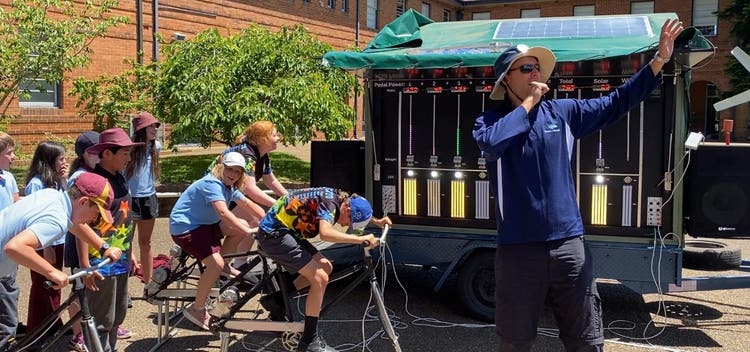


Program Activities
Please Note: This program can run in 2 sessions between recess/lunch, subject to schools bell times.
Key Syllabus Outcomes
Investigates by posing questions, including testable questions, making predictions and gathering data to draw evidence-based conclusions and develop explanations:
Students question and predict by:
-
with guidance, posing questions to clarify practical problems or inform a scientific investigation (ACSIS231, ACSIS232)
-
predicting what the findings of an investigation might be (ACSIS231, ACSIS232)
-
applying experience from similar situations in the past to predict what might happen in a new situation Students plan investigations by: • with guidance, planning appropriate investigation methods to test predictions, answer questions or solve problems including surveys, fieldwork, research and fair tests (ACSIS086, ACSIS103, ACSHE081, ACSHE098)
-
deciding which variable should be changed and measured in fair tests while keeping everything else the same (ACSIS087, ACSIS104)
Students conduct investigations by:
-
working individually and collaboratively in conducting a range of appropriate investigation methods, including fair tests, to answer questions or solve problems using suitable equipment and materials, checking observations and measurements by repeating them where appropriate using equipment and materials safely, identifying potential risks (ACSIS088, ACSIS105)
-
accurately observing, measuring and recording data, using digital technologies as appropriate (ACSIS087, ACSIS104)
-
using formal units and abbreviations for measuring and recording data • suggesting improvements to the methods used to investigate a question or solve a problem (ACSIS091, ACSIS108)
Students process and analyse data and information by:
-
constructing and using a range of representations, including tables, graphs (column, picture, line and divided bar graphs) and labelled diagrams
-
using numerical techniques to analyse data and information, including calculating the means and percentages of small sets of data
Students:
-
describes how scientific understanding about the sources, transfer and transformation of electricity is related to making decisions about its use ST3-6PW
-
uses scientific knowledge about the transfer of light to solve problems that directly affect people’s lives ST3-7PW
-
Electrical circuits provide a means of transferring and transforming electricity. (ACSSU097)
Students:
-
identify potential risks and demonstrate safe use when using electrical circuits and devices
-
demonstrate the need for a circuit to be complete to allow the transfer (flow) of electricity
-
observe and describe how some devices transform (change) electricity to heat energy, light, sound or movement, eg hair dryers, light globes, bells and fans
-
Energy from a variety of sources can be used to generate electricity and this knowledge can inform personal and community-based decisions about using these sources sustainably. (ACSSU219)
Students:
-
research and present ideas about the different ways electricity can be generated, eg burning coal or natural gas; solar, hydroelectric, geothermal, wind and wave-generated electricity
-
describe how scientific knowledge can be used to inform personal and community decisions about the use and conservation of sustainable sources of energy (ACSHE217, ACSHE220)
Students:
- develop knowledge, understanding of and skills in applying the processes of Working Scientifically
- SC4-6WS & SC5-6WS: follows a sequence of instructions to safely undertake a range of investigation types, collaboratively and individually
- SC4-7WS & SC5-7WS : processes, analyses and evaluates data from first-hand investigations and secondary sources to develop evidence-based arguments and conclusions
- SC4-8WS & SC5-8WS: applies scientific understanding and critical thinking skills to suggest possible solutions to identified problems
-
explains how scientific understanding about energy conservation, transfers and transformations is applied in systems SC5-11PW
-
Content:
- investigate how magnets and electromagnets are used in some everyday devices or technologies used in everyday life
PW3 Energy appears in different forms including movement (kinetic energy), heat and potential energy, and causes change within systems. (ACSSU155)
-
identify objects that possess energy because of their motion (kinetic) or because of other properties (potential)
-
relate electricity with energy transfer in a simple circuit
-
investigate some everyday energy transformations that cause change within systems, including motion, electricity, heat, sound and light
-
identify that most energy conversions are inefficient and lead to the production of heat energy, eg in light bulbs
-
research ways in which scientific knowledge and technological developments have led to finding a solution to a contemporary issue, eg improvements in devices to increase the efficiency of energy transfers or conversions
-
discuss the implications for society and the environment of some solutions to increase the efficiency of energy conversions by reducing the production of heat energy
Additional content: debate intergenerational implications of the use of non-renewable energy resource
-
explains how scientific understanding about energy conservation, transfers and transformations is applied in systems SC5-11PW PW3
Scientific understanding of current electricity has resulted in technological developments designed to improve the efficiency in generation and use of electricity
-
describe qualitatively the relationship between voltage, resistance and current
-
outline recent examples where scientific or technological developments have involved specialist teams from different branches of science, engineering and technology, eg low emissions electricity generation and reduction in atmospheric pollution
PW4 Energy conservation in a system can be explained by describing energy transfers and transformations. (ACSSU190)
Students:
-
apply the law of conservation of energy to account for the total energy involved in energy transfers and transformations
-
describe how, in energy transfers and transformations, a variety of processes can occur so that usable energy is reduced and the system is not 100% efficient
-
discuss, using examples, how the values and needs of contemporary society can influence the focus of scientific research in the area of increasing efficiency of the use of electricity by individuals and society (ACSHE228, ACSHE230)
-
discuss viewpoints and choices that need to be considered in making decisions about the use of non-renewable energy resources
Additional content:
-
explain the relationship between resistance, voltage and current, using Ohm's Law
-
investigate the energy efficiency of appliances and relate this to a house
Contact us
Get in touch to ask a question, plan a visit or find out more about what we offer.
About our centre
Learn how our centre helps students explore, learn and connect with nature.